 Hosted and created by Bodegas Paternina at its Conde de los Andes winery in Ollauri, the exhibition entitled “Tinta, Sangre y Vino” – “Ink, Blood and Wine” – celebrates the writer’s visit to the winery 55 years ago and marks 50 years since his death.
However, the exhibition does not focus solely on Hemingway’s visit to Paternina in 1956.
Making use of never-before-seen photographs and working with the Hemingway family, Paternina’s exhibition is more of a look at Hemingway’s association with Spain in the final years of his life.
Greater attention is given to his passions for wine in general, bullfighting, writing, fiestas and good company. Carlos Eguizábal, CEO of Paternina, spoke to the drinks business at the opening ceremony in Ollauri.
“We felt the exhibition was appropriate because of his relationship with wine and Rioja in general,” he said.
“There is a connection between wine, culture, bullfighting and literature which Rioja encapsulates and which underpinned his love of Rioja and Paternina. It’s a celebration of his life.”
Hemingway’s daughter-in-law Valerie and grandson John were also at the opening of the exhibition and Valerie tolddb about the author and his connections with wine.
“He was always looking for what was good,” she said. “Not always the best but what he could enjoy. He didn’t follow trends or labels or vintages but wine was part of the fabric of his life.”
As for his reputation as a heavy drinker (and at worst a drunk), Valerie countered: “He was very disciplined with his drinking and never drank because he ‘needed’ the drink. He would also never write after drinking, saying: ‘Anything you write after drinking is worthless’.”
Much of the exhibition centres on Hemingway’s return to the bullfights between 1956 and 1960.
His visit to Paternina in 1956 coincided with the coming of age of Antonio Ordóñez son of the bullfighter Cayetano Ordóñez also a friend of Hemingway and model for the character Pedro Romero in The Sun also Rises.
Antonio was on a tour of the Basque country and Rioja in 1956 and Hemingway followed his fights in cities such as Bilbao, Pamplona, Haro, Logroño and Calahorra.
It was on this trip that the two of them visited Paternina and a great many of the unseen photographs in the exhibition show the pair being shown around the cellars – and tasting wine.
Hemingway would follow Antonio on subsequent returns to Spain between 1956 and 1960.
These, along with the mano a mano contest between Antonio and his great rival and brother-in-law Luis Miguel Dominguín in 1959, formed the basis of Hemingway’s last series of articles for Life magazine, The Dangerous Summer.
To help commemorate the event, Paternina’s winemaker Carlos Estecha has designed a special edition label for the 2006 Conde de los Andes reserva.
The exhibition runs from Tuesday to Sunday – with more limited opening times on Sunday – until 15 April 2012. Admission with a tasting is €3, €2 for over 65s and under 18s and free for under 14s.
 When Spanish bullfighter Serafin Marin plunges his sword into the back of a bull's neck in Barcelona on Sunday, he will be marking the end of an era. The bull will not only be the last of six killed in the bullfight, but the last-ever to be killed in Barcelona's Monumental bullring, which is nearly a century old. The closure of the Monumental - in keeping with a bullfighting ban in the north-eastern region of Catalonia - reflects the decline of bullfighting in Spain, though fans of the country's 'national fiesta' vow to fight on. 'We have lost a battle, but not the war,' Marin told the daily El Mundo. But animal rights campaigner Aida Gascon said, 'Now that we have achieved (the end of bullfights) in Catalonia, we shall try to finish with them in the rest of Spain.' Catalonia, a wealthy region of 7.5 million people, has spearheaded the campaign against bullfights, or 'corridas,' in a country where animal rights activism is on the rise. The Catalan capital of Barcelona declared itself an 'anti-bullfight' city in 2004. Dozens of other municipalities followed suit, and finally in July 2010 the regional parliament outlawed bullfights from January 1, 2012. The Canary Islands had already done so in 1991, as part of a more general animal protection law, but that decision had gone largely unnoticed. The Catalan opposition to bullfights is explained not only by animal rights activism, but also by Catalan nationalism, many of whose representatives see 'corridas' as an expression of Spanishness. The region with separatist currents 'wants to eliminate everything that represents Spain,' Marin said. Bullfighting remains an important industry in Spain with an annual turnover of more than 2.5 billion euros (3.5 billion dollars), contributing to 0.25 per cent of gross domestic product. It provides direct employment to 200,000 people, including bullfighters, or 'toreros,' bull breeders, managers and others. Yet gradually the spectacle that once inspired artists and writers such as Pablo Picasso and Ernest Hemingway is losing its appeal. Only 37 per cent of Spaniards are interested in bullfights, while 60 per cent dislike them, according to a 2010 poll. 'Corridas' are least popular among young people. Animal rights campaigners see the event, in which darts are stuck into the back of the animal's neck before the 'torero' kills it with his sword, as torture. Some observers attribute the decline also to other causes, ranging from Spain's economic crisis to an alleged deterioration of the race of the Iberian 'brave bull.' Not only are bulls' horns 'shaved' to make them less dangerous, but they are also losing their fighting spirit, some bullfighting commentators complain. Another important reason for the decline of 'corridas' is their image as an old-fashioned form of entertainment. 'Young people do not choose an anachronistic spectacle,' anti-bullfight campaigner Helena Escoda said. Even Catalonia, however, has not outlawed other bull spectacles, such as bull runs. Some Spanish regions have come out in defence of the 'corrida,' describing it as a part of their cultural heritage. Prime Minister Jose Luis Rodriguez Zapatero's government placed bullfights under the responsibility of the Culture Ministry, instead of the Interior Ministry. The opposition conservative People's Party, which is expected to win the November 20 parliamentary elections, has taken legal action against the Catalan bullfighting ban at the Constitutional Court. Catalan bullfighting enthusiasts have also collected 300,000 signatures in defence of the fiesta. Yet it is far from certain that such initiatives will stop what many see as an inevitable social development. Catalan bullfighters, in the meantime, are planning to face the bull elsewhere in Spain or in the south of France.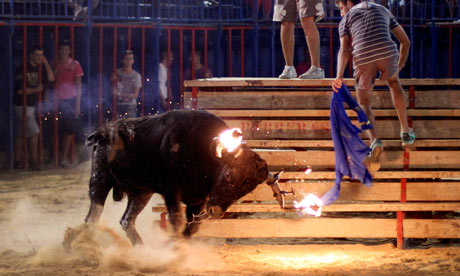
 Palestinian leader Mahmoud Abbas has submitted his bid to the UN for recognition of a Palestinian state. To rapturous applause in the General Assembly, he urged the Security Council to back a state with pre-1967 borders. He said the Palestinians had entered negotiations with Israel with sincere intentions, but blamed the building of Jewish settlements for their failure. Israeli PM Benjamin Netanyahu said he was reaching out to Palestinians and blamed them for refusing to negotiate. "I continue to hope that President Abbas will be my partner in peace," he said in his speech in New York. "Let's meet here today in the United Nations. Who's there to stop us?" Mr Netanyahu added that the core of the conflict was not settlements but the refusal of the Palestinians to recognise Israel as a Jewish state. Hours after receiving it, UN Secretary-General Ban Ki-moon transmitted the Palestinian request to the Security Council. Israel and the US say a Palestinian state can only be achieved through talks with Israel - not through UN resolutions. 'Come to peace' President Barack Obama told Mr Abbas on Thursday that the US would use its UN Security Council veto to block the move. Continue reading the main story Analysis Jeremy Bowen BBC Middle East editor, New York Some delegations here at the UN in New York gave Palestinian Authority leader Mahmoud Abbas a standing ovation - they were clapping and even whistling in support. That is significant because if it comes to a vote in the Security Council - and if the Americans veto it - Palestinians have a Plan B. That Plan B is to go to the General Assembly - where there are no vetoes - and get enhanced status, not full membership but something better than they have now. The Palestinians say they want to negotiate but not in the way they have negotiated before - there has to be clear parameters and a timetable. The Palestinian point is that since 18 years of negotiation has not worked, let's try something new. "I call upon the distinguished members of the Security Council to vote in favour of our full membership," he told the General Assembly, in what was for him an unusually impassioned speech. He added that he hoped for swift backing. Many delegates gave him a standing ovation. "I also appeal to the states that have not yet recognised the State of Palestine to do so." "The time has come for my courageous and proud people, after decades of displacement and colonial occupation and ceaseless suffering, to live like other peoples of the earth, free in a sovereign and independent homeland," he said. He urged Israel to "come to peace". And he said the building of Jewish settlements was "the primary cause for the failure of the peace process". A spokesman for the Islamist movement Hamas, which controls the Gaza Strip, criticised the speech. Salah Bardawil said Mr Abbas had deviated from the aspirations of the Palestinian people by accepting the 1967 borders, which he said left 80% of Palestinian land inside Israel. 'Future and destiny' Meanwhile in the West Bank, crowds roared their approval as Mr Abbas demanded UN acceptance of a Palestinian state within pre-1967 borders. Continue reading the main story Middle East viewpoints Analyst Yezid Sayigh argues that US and Israeli policies have forced the Palestinians to resort to requesting full UN membership. Israeli commentator Yossi Klein Halevi argues that the Palestinians need to convince the Israelis that any state would not be a threat. "With our souls, with our blood, we will defend Palestine," they said. Mr Abbas had called for peaceful marches in support of his initiative, but some clashes were reported: One Palestinian was shot dead by Israeli troops during clashes in the village of Qusra, south of Nablus, Palestinian sources say At the Qalandiya checkpoint, Israeli troops fired tear gas on stone-throwing Palestinian youths In the village of Nabi Saleh, protesters burned Israeli flags and pictures of President Obama The process began with Mr Abbas presenting a written request for a State of Palestine to be admitted as a full UN member state to the UN secretary general. The BBC's Kim Ghattas at the UN says that until the last minute Western diplomats tried and failed to stop the Palestinians making the request. Even now, efforts are under way to restart direct talks between the Israelis and Palestinians in an attempt to defuse tensions, our correspondent says. The Security Council will examine it and vote on the request. In order to pass, it would need the backing of nine out of 15 council members, with no vetoes from the permanent members. A Security Council vote could take weeks to come about and the US may not even need to exercise its veto - Washington and Israel have been lobbying council members to either vote against the Palestinian plan or abstain. Continue reading the main story Palestinian UN membership bid Palestinians currently have permanent observer entity status at the UN They are represented by the Palestine Liberation Organisation (PLO) Officials now want an upgrade so a state of Palestine has full member status at the UN They seek recognition on 1967 borders - in the West Bank, including East Jerusalem, and Gaza Enhanced observer member status could be an interim option Q&A: Palestinians' UN statehood plans Why Obama has turned towards Israel French President Nicolas Sarkozy has urged a compromise, suggesting the General Assembly give the Palestinians enhanced status as a non-member state to allow a clear timeline for talks - a month to start negotiations, six months to deal with borders and security and a year to finalise a "definitive agreement". A vote on enhanced status - enjoyed by others such as the Vatican - would not require a Security Council recommendation but a simple majority in the General Assembly, where no veto is possible. Currently the Palestinians have observer status at the UN. The "Quartet" of US, European, Russian and UN mediators has been working on reaching a framework agreement to restart talks, based on Mr Obama's vision of borders fashioned from Israel's pre-1967 boundary, with agreed land swaps.
 France's fines on women for wearing the full-face covering niqab veil, imposed for the first time by a court on Thursday, are a "travesty of justice," Amnesty International says. Police have issued several on-the-spot fines since the ban came into force in April but the hearing saw the first two court-issued fines, and the Muslim women vowed to appeal their case all the way to the European Court of Human Rights. "This is a travesty of justice and a day of shame for France. These women are being punished for wearing what they want," Amnesty International's deputy director for Europe and Central Asia John Dalhuisen said in a statement. Advertisement: Story continues below "Instead of protecting women's rights, this ban violates their freedom of expression and religion." The court in the northern cheese-making town of Meaux ordered Hind Ahmas, 32, to pay a 120 ($A163) fine, while Najate Nait Ali, 36, was fined 80 euros. It did not order them to take a citizenship course, as the prosecutor had wanted. The women were arrested when they brought a birthday cake for local mayor and lawmaker Jean-Francois Cope, who is head of President Nicolas Sarkozy's right-wing UMP party that pushed through Europe's first anti-burqa law. France is not the only country to try to ban the Muslim full-face veil - Belgium and some Italian cities have similar laws, while other countries are planning to follow suit - so a European ruling could have broad effect. French officials estimate that only around 2,000 women, from a total Muslim population estimated at between four and six million, wear the full-face veils traditionally worn in parts of the Arab world and South Asia. Many Muslims and rights activists say the right-wing president is targeting one of France's most vulnerable groups to signal to anti-immigration voters that he shares their fear that Islam is a threat to French culture.
 U.S. deep-sea explorers must turn over to the Spanish government 17 tons of silver coins and other treasure recovered from a sunken Spanish galleon in 2007, a federal appeals court ruled Wednesday. But Tampa, Fla.-based Odyssey Marine Exploration has vowed to continue the protracted legal battle over the cache, which could be worth as much as $500 million. In a statement Wednesday, the company said it would take the next step in the appeals process, requesting a hearing before all the judges of the 11th Circuit Circuit Court of Appeals. That came after a three-judge panel of the 11th Circuit had issued its ruling in a case that could case spill over to treasure hunts for years to come. "We are certainly disappointed by the 11th Circuit's ruling," said Melinda MacConnel, Odyssey's vice president and general counsel. "We believe the U.S. Constitution and all other applicable laws give jurisdiction to the U.S. courts to determine the rights of Odyssey, Spain and all other claimants in this case." Attorneys for Odyssey asked the three-judge panel to overturn a lower court ruling and uphold the "finders keepers" rule that would give the treasure hunters the rights to coins, copper ingots, gold cufflinks and other artifacts salvaged in April 2007 from the galleon found off the coast of Portugal. Spain's lawyers countered that U.S. courts are obligated by international treaty and maritime law to uphold Spain's claim to the haul. The ship, called the Nuestra Senora de las Mercedes, was sunk by British warships in the Atlantic in 1804 while sailing back from South America with more than 200 people on board. Odyssey created an international splash in May 2007 when it announced that it had recovered more than 500,000 silver coins and other artifacts from the wreck and flew the treasure back to Tampa. Spain went to the U.S. District Court in Tampa, where the company is based, claiming ownership. Odyssey disputed the Spanish government's ownership of the valuable cargo. James Goold, a Washington attorney who represented the Spanish government in court, called the appeals court decision "a complete and much-deserved victory." "The court recognized that stripping the sunken Spanish ship of coins to sell to collectors is no more appropriate than to do that to the USS Arizona in Pearl Harbor," Goold said. "We are pleased and gratified that the court recognized U.S. obligations under international law, just as Spain respects the sanctity of sunken U.S. Navy ships." A federal judge sided with Spain in the first round of the tug-of-war in June 2009, accepting the Spanish government's argument that it never surrendered ownership of the ship and its contents. Attorneys argued the case before the 11th Circuit panel in May. Odyssey had argued that the wreck was never positively identified as the Nuestra Senora de las Mercedes. And if it was that vessel, then the ship was on a commercial trade trip — not a sovereign mission — at the time it sank, meaning Spain would have no firm claim to the booty. International treaties generally hold that warships sunk in battle are protected from treasure seekers.
 Designer clothes owned by Hollywood legend and fashion icon Elizabeth Taylor, including haute couture by Chanel, Yves St. Laurent and Dior, will be sold at auction in New York, Christie's said on Wednesday. The silk chiffon dress that the Academy Award winning actress wore for her first wedding to actor Richard Burton will be among the nearly 400 times included in the four-day series of sales in December. "One of the many great treasures within Elizabeth Taylor's vast collection is her extraordinarily well-preserved wardrobe," said Marc Porter, chairman and president of Christie's Americas. "The stunning outfits she wore to galas, award ceremonies, AIDS benefits and even her own weddings to Richard Burton are all here, lovingly maintained along with the handbags, shoes, hats and other accessories that completed her superstar looks," he added in a statement. The December 13-16 sales, which span over 50 years of fashion, will follow a global three-month tour which will also includes Taylor's renowned jewelry, fine art and memorabilia. It will be the second in a series of auctions from the estate of the legendary film star who died in March. Nearly 6,000 people viewed the collection this month when it was displayed in Moscow. Stops in Los Angeles, London, Dubai, Geneva, Paris, Hong Kong and New York will follow. Meredith Etherington-Smith, Christie's' curator for the fashion auction, described the items as "a highly personal collection." "This is not a red carpet wardrobe edited by stylists but a treasure trove of looks chosen by the last of the great movie stars. Many of the pieces in this lifetime collection were couture, custom made for Ms. Taylor by designers who became her close friends, including Valentino Garavani, Gianni Versace and Gianfranco Ferre." Some 68 of Taylor's most iconic looks will be auctioned at a gala evening sale on December 14, followed by hundreds of other fashion items and accessories in other sales. Highlights will include a Versace beaded evening jacket arrayed with portraits of the actress in some of her famous movie roles, which is estimated to sell for up to $20,000. The sunflower yellow dress by Hollywood designer Irene Sharaff that Taylor wore to her 1964 wedding to Burton has an estimated sale price of $40,000 to $60,000. Taylor's estate was valued at up to $1 billion when she died of congestive heart failure at age 79. A portion of the proceeds from the exhibitions, events and publications related to the auction will be donated to The Elizabeth Taylor AIDS Foundation, which the actress founded in 1991. The series of Taylor sales are individually devoted to jewelry, haute couture, fashion and accessories, decorative arts and memorabilia from Taylor's Bel Air home, and Impressionist and modern art.
 Fugitive Libyan leader Muammar Gadhafi was spotted in the southern city of Sabha a few days ago, the regional daily Asharq al-Awsat reported on Tuesday, citing an eyewitness. The witness claimed that Gadhafi was living in the city, located around 750 kilometers south of the capital Tripoli. Anti-Gadhafi fighters firing a cannon near Sirte, the hometown of deposed leader Muammar Gadhafi, September 17, 2011. Photo by: Reuters Gadhafi's whereabouts have been unknown since rebels took over Tripoli in August. However, he continues to send statements and voice messages through the Syria-based al-Rai channel. The report comes after the anti-Gadhafi rebels said they took over parts of Sabha city as well as its airport. "The airport of Sabha has been liberated by our fighters," a military spokesman, Colonel Ahmed Bani, said in Tripoli on Monday. "Also two villages near Sabha have been liberated." For around a week the rebels have been fighting pro-Gadhafi fighters, who have put up stiff resistance in his birthplace of Sirte and the desert town of Bani Walid, south-east of Tripoli. Almost a month after they overran Tripoli, the rebels are at pains to take control of the two strongholds before their leaders can declare all of the North African country "liberated."
 Located on the Southern Spanish Costa del Sol, in the heart of the 'Golden Mile' only 5 minutes to Old Town Marbella and Puerto Banús, with 320 days of sunshine and a mild year round average temperature of 21ºC). Open year round, the renowned Marbella Club Hotel, was once the private residence of Prince Alfonso von Hohenlohe. The 121 luxury bedrooms and suites, spread over the beach front resort, harmonize with 14 Andalusian-Style villas throughout 42,000 square meters (452,083 sq. ft.) of lush subtropical gardens. Each guest room is decorated with the finest fabrics and Mediterranean interior design, reflecting the surrounding elements and has furnished balcony / terrace and spacious luxurious bathrooms with separate shower and bath. The 14 charming villas are in the unmistakable style of the Hotel, faithful replicas of traditional Andalucían architecture, blending harmoniously with their surroundings, and are ideal for families and guests seeking to enjoy more space and privacy. The 2, 3 or 5 bedroom villas have their own private garden and heated pool, providing guests with both comfort and privacy during their stay. Both of the 2 outdoor heated swimming pools, one with seawater invite you to relax in the surrounding gardens or to enjoy the views of the Mediterranean through the palm trees of the famous beach club.
 The plane, a P-51 Mustang, dubbed the "Galloping Ghost" that was being flown by Jimmy Leeward, 74, crashed at 4.30pm local time (11.30pm GMT) into a box seat area in front of the main grandstand at the Reno Air Races,. "I heard his engine and looked up. He was within 100 feet. He was coming right down on top of us," witness Fred Scholz told CNN, adding that the plane had first flown closer to the stands than allowed. "It just happened very quick." The Federal Aviation Administration halted the air race after the crash, and was investigating the incident alongside the National Transportation Safety Board, an FAA official said. Video apparently taken from the stands and posted on YouTube showed a plane plunging nose-down into the tarmac as spectators were heard gasping: "Oh, my God." Debris billowed near the crash site, and officials then told spectators to remain where they were so emergency workers could get to the scene. The FAA official, spokesman Ian Gregor, said that multiple spectator fatalities and critical injuries were reported. FAA inspectors had been observing the race at the time of the crash, he said. The head of the Reno Air Racing Association, Michael Houghton, put the number of injured at 54 people and said the 74-year-old pilot was among those killed. He said that there appeared to be a "problem with the aircraft that caused it to go out of control". At least 15 people were in a critical condition after the crash, which a spokesman for the event called a "mass casualty situation" in a written statement. Mark Hasara of Cedar Rapids, Iowa, is a veteran of the Air Force who attended the race and witnessed the crash. "As soon as I saw his nose pointed at the ground, I knew he wasn't going to recover," Mr Hasara told Reuters. The Reno Air Races, which began in the mid-1960s and is an event that is held annually, feature planes facing off in multi-lap races at an airfield north of Reno. Renown Regional Medical Center spokesman Dan Davis said that at least two people were killed, a man and a woman, but they were not identified. Stephanie Kruse, a spokeswoman for the regional emergency medical service authority, said 15 of the injured were in a critical condition. "This is a very large incident, probably one of the largest this community has seen in decades," Ms Kruse told the Associated Press. "The community is pulling together to try to deal with the scope of it. The hospitals have certainly geared up and staffed up to deal with it." Mr Houghton said that Mr Leeward, from Ocala, Florida, was a real estate developer who had been racing planes since the mid-1970s. He added that most of Leeward's family had been at Friday's event. Ronald Sargis, a witness who was sitting in the box-seat area, said spectators could tell the plane was in trouble before it crashed. "About six or seven boxes down from us, it impacted into the front row," Mr Sargis told KCRA-TV in Sacramento. He added: "It appeared to be just pulverised." Another eyewitness, Maureen Higgins of Alabama, told the Associated Press that the pilot was on his third lap when he lost control. "I saw body parts and gore like you wouldn't believe it. I'm talking an arm, a leg," Ms Higgins said.
 Back in early September, the recruitment committee of the Council of Saudi Chambers of Commerce and Industry announced that recruitment companies would be established and will be licensed to bring in housemaids from Morocco, East Asia and South Africa. The move has caused outrage in unusual places. The reason for this recruitment move, according to a Saudi chamber official, was that they were turning to Morocco and other countries to get its domestic workers following a dispute with the Philippines and Indonesia, the largest suppliers of housemaids to the Gulf countries. The dispute has centered on pay and conditions, but Indonesia had earlier this year also criticized the Saudi government for beheading an Indonesian maid. Of the 1.2 million Indonesians working in Saudi Arabia, over 70% are domestic helpers. The ban on maids from Indonesia and the Philippines hit Saudi households hard, causing many to resort to hiring illegal maids over Ramadan. The Saudis are reliant on foreign workers to perform their household tasks for them and very few Saudi women will work in such menial positions despite high unemployment, as they would be looked down on by other Saudis. The ban came into effect following the two countries attempts to introduce regulations for the work conditions of their nationals. Trade Arabia said both countries demanded better working conditions for their employees. Saudi walked away from the negotiations abruptly and decided to look for domestic employees from countries such as Morocco who they perceive as not as concerned about imposing regulations to protect their workers. It also became clear that lower rates of pay could be offered to other nationals. Right from the beginning the scheme ran into problems in respect to recruiting maids from Morocco. The recruitment committee said that the immediate employment of Moroccan maids could prove an issue as there were no official recruitment offices in Morocco to process the papers of prospective domestic helps. It was suggested that there could be a way around the problem with Saudi citizens being given work visas to bring housemaids from Morocco on their own. The whole issue of Saudi maids has been at the centre of international protests for years, especially in regard to exploitation, sexual harassment and torturing of foreign housemaids. The notion that individual Saudi's could fly to Morocco and find a young woman and take her back to Saudi, is truly worrying and will, no doubt, offend our readers. The chairman of the Council of Saudi Chambers of Commerce and Industry, warned Saudi citizens against contacting any offices claiming to be able to send housemaids from Morocco to the Kingdom. "They are all fake. You should not heed the false claims of these fake offices." he warned prospective employers. The spokesman of the Labor Ministry, Hattab Al-Anzi, said the recruitment offices would grant citizens work visas for housemaids from Morocco. "It is now the responsibility of the citizen to look for authorized private recruitment offices to bring workers from Morocco," he said. Then, suddenly, the plan to import maids from Morocco ran into even more problems. Those fighting to stop the "maid-trade" got support from an unlikely source - Saudi women. They objected to the importing of Moroccan girls, not because they didn't think they would work hard, or that they were against the exploitation of young foreign women. No - it was because they thought the Moroccan women were too beautiful. At first it sounded like a sick joke, but the Saudi women were serious. "Many Saudi woman have objected to plans to import domestic workers from Morocco…they say the Moroccan women are beautiful and this will cause continuous anxiety and concern in Saudi families,” - 'Sharq' Daily It is a relatively rare for the voices of Saudi women to be raised in protest. This year there have been notable exceptions as some women protested for the right to drive, whilst others demanded the right to vote. Now they have another common cause - to ban female domestic maids from Morocco. It started slowly, but over a few days the protests grew to the point where the Saudi women inundated the government with complaints that Moroccan women are just too beautiful and may lure their husbands away. According to the website Emirates 24 the Shura Council was “deluged by demands from Saudi women” "Moroccan women are so attractive that their husbands could easily fall for them…others said Moroccans are good at magic and sorcery and that this could enable them to lure their husbands.” - 'Sharq' Daily If the women of Saudi Arabia fail to stop this "maid-trade" then it is imperative that the Moroccan government scrutinize the contracts and conditions of every maid taken to Saudi. They should also take steps to educate Saudi women to understand that while Moroccan women may be beautiful, they are not dangerous.
 Spanish police say a human smuggler trying to sneak two Moroccans into Spain by crossing the Strait of Gibraltar on a jet ski threw them into the water when detected by coastal authorities and that one drowned. A Civil Guard statement Tuesday said the incident happened Sept. 9 near the Spanish town of Tarifa. The Moroccan driver has been charged with negligent manslaughter. One of the travelers managed to swim ashore after being dumped 500 meters from it, but the other did not survive. Spain is a lure for poor North and sub-Saharan Africans because it is Europe's southern gateway. Every year, thousands try to reach the Spanish mainland or Spain's Canary Islands off the coast of west Africa.


